About this site
We write the page we could not find
Signed Hazel Renwick Editor · the partner's side
Most writing about widowhood is either clinical or sentimental. This site tries to be neither: it answers the question that was actually asked, says plainly when there is no good answer, and does not pretend to an experience it has not had.
Who writes this
I came to this subject sideways, as the person who was not bereaved. I had fallen for a man whose wife had died, and almost everything written for me at the time was addressed to somebody else: either to him, gently, or to me as a problem he would eventually solve. What I actually needed was a plain description of what was happening in the house I was standing in, and how much of it was ordinary.
The questions I arrived with were small and unaskable at the same time. Whether it was reasonable to mind a photograph. What to do on a date that a calendar had quietly ruined. Whether being compared to someone I could not meet was in my head. Whether a silence at eight in the evening was about me at all. None of it was a crisis, all of it needed somewhere to be put, and what I found instead was either pity or a script for handling him.
So that is what these pages are: the question as it was actually asked, answered in the first two sentences, with the place where the evidence runs out said out loud. I am not qualified to tell anybody how to grieve, and I would not trust a page that offered. Where a page ends, it names the kind of help the next step belongs to and stops there.
What I arrived with
A stack of questions that felt too small to ask anyone and too loud to ignore. Every article I could find was either clinical about grief or sentimental about second chances, and neither one told me what tended to happen next, or in what order.
What changed the writing
Noticing that most of what unsettled me was structural rather than personal — a date landing near an anniversary, a family who had not been asked to make room for me, a silence that belonged to a particular Tuesday. Described accurately, it stopped needing to be graded. That is the whole editorial method here.
What these pages refuse
No readiness tests, no scoring anybody, no diagnosis of a person we cannot see, and no scripts for managing a grieving partner. Nothing about how long anyone should wait: no such interval exists, and a page that invents one is guessing at somebody else’s life.
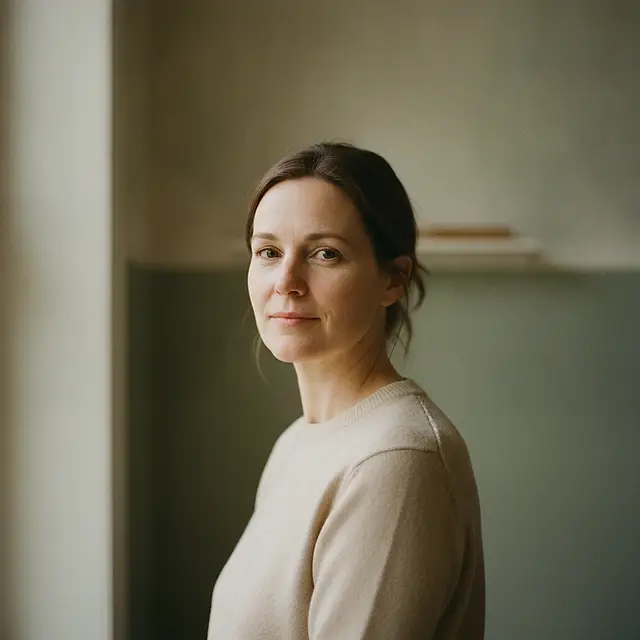
Hazel Renwick is a pen name, and it belongs to this site’s editorial team rather than to a biography you could look up. The name exists so that a page has somebody answerable for it, and it is not there to lend a page weight the text has not earned. There are no credentials behind it: nobody here is a therapist, a doctor or a grief counsellor, and no page is written as though it were. The portrait at the top of this page is not a photograph of a living person — it is an illustration generated with an AI tool, labelled as one wherever it appears, and it is there to give a byline a face rather than to tell you whose. What the name does not claim is the loss itself: nobody writing here has been widowed, and no page here speaks in the first person about burying a husband or a wife. Drafting is AI-assisted and human-edited, every figure is traced to a named publisher before it appears, and if a sentence here is wrong the fastest route to fixing it is editors@widowedlove.com with the page address and the sentence you are disputing.
How the pages are made
Behind the byline is the Widowed Love editors. There is no invented author and no borrowed credential. What we do is narrower and, we think, more useful: take the questions people actually type at 2am, answer them in the first two sentences, and say where the evidence runs out.
Every number is checked against a primary source before it is published — the list is on the sources page, together with what we rejected and why.
The named contributor
Marten Elder
Named contributor · widower
Marten Elder is a widower and a named contributor to this site. He is a real person, his name is used with his permission, and there is no photograph and no likeness of him here because that is his decision and it is the right one to respect. He is not a byline and not a reviewer. Nothing appears in his name that he has not confirmed word for word, which is why there is not a single quotation from him on this site yet: the interview is still ahead of us, and when it happens every quote will carry the date he confirmed it.
What this site will not do
These are not promises. Each one is a rule the site is built to enforce, and the reason a page occasionally says less than it could.
- 01
Nothing is published in someone’s name without their word
Lived experience appears as a quotation with a name and the date it was confirmed. Nothing is reconstructed, composited, or written in anyone’s voice. If he did not say it, it does not appear.
- 02
Every number traces to a primary source
Each figure names its publisher and year in the same sentence, and links the study rather than an article about the study. Anything we could not read on the source itself was dropped — including three widely-repeated claims about widowhood, listed on the sources page.
- 03
No invented credentials, ever
We are not therapists, doctors or grief counsellors, and no page here claims otherwise. There is no fabricated expert, no borrowed title, and no professional review we did not have.
- 04
No paid placements
Nobody pays to be recommended here, and no ranking on this site is for sale. Where a link earns us something, it is marked as such on the page it appears on.
 Illustration
Corrections and contact
If we get something wrong we correct it on the page and say that we did. Our process, sourcing standards and corrections policy are documented in the editorial policy, including how this site uses AI tools and how its images are made.
Email editors@widowedlove.com or use the contact page. Corrections, sources we have missed and disagreements are all welcome — particularly from people who have been widowed.