Widow’s fire is the informal name for the sudden sexual desire that can follow a spouse’s death, and almost nobody asks what is widow’s fire until it is already happening to them. The phrase gets typed into a search box at an odd hour, weeks or months after a funeral, by someone who has just discovered that grief and desire can occupy the same body at the same time — and who would far rather ask a search engine than a friend.
This page is the plain account: what the phrase describes, where it came from, what people report, and what they do about it. It is written by editors. It is not therapy and it is not a diagnosis.
What is widow’s fire?
It is a surge of sexual desire after a spouse dies. Usually sudden. Frequently unwelcome. Almost always earlier than the person feels entitled to it.
The word fire is doing real work in the phrase. People who describe it rarely describe romance or longing for a new partner. They describe something closer to a physical alarm: restlessness, an ache to be touched, sleep that will not come, thoughts that arrive in the middle of a supermarket and have nothing to do with anybody present.
It is not the same as wanting to date. Many people feel it while the idea of a dinner with a stranger is still unthinkable. That mismatch — a body that seems to have moved at one speed and a heart at another — is the part that makes people think something has gone wrong with them.
Where did the phrase widow’s fire come from?
Widow’s fire is a community word, not a clinical one. It spread through blogs, memoirs and widow forums — British writing on bereavement popularised it particularly — because thousands of people needed a name for something no leaflet mentioned.
That origin matters in two directions. It means the phrase is real in the only sense that counts: enough people recognised the experience instantly for the term to stick. It also means there is no diagnostic definition, no threshold, and no test. Anyone offering you a checklist of “widow’s fire symptoms” is describing, not measuring.
You will see it written as widow fire syndrome. Syndrome is the wrong word here: nothing about this is a syndrome, and dressing it up as one adds a suggestion of illness to something that is, for most people, an ordinary and temporary consequence of losing the person they slept beside.
Why it happens
The honest answer is that nobody has established a single mechanism, and we are not the people to invent one. What people who have lived it tend to say fits together well enough to be worth setting out.
Bereavement is physical before it is anything else. Sleep breaks, appetite goes strange, the body runs on adrenaline for weeks. A system in that state does not politely wait for the heart to catch up.
Then there is touch. Long marriages are made of ordinary contact that nobody counts — for example, a hand on a shoulder, a leg against a leg in bed, someone reaching past you in a kitchen. That disappears overnight and, for many widowed people, is never replaced by anything. Touch-hunger is the need for ordinary physical contact of any kind, and what gets read as sexual hunger is often, at least in part, that.
And desire is a signal of being alive, which arrives at exactly the moment a person has been steeped in death. Several people describe it as their body arguing with the funeral.
When does widow’s fire start and end?
There is no schedule, and any page giving you a number for this is inventing one.
Some people describe it within days, sometimes before the funeral, which is the version that produces the most shame. Others describe nothing for a year and then a sudden arrival, often triggered by something ordinary, such as a film, a smell, or a stranger being kind. Some never experience it at all and later feel oddly excluded reading about it.
What most accounts agree on is that it changes rather than ends. The shocking, constant early version tends to become intermittent, then simply part of the ordinary weather of a life. When people ask when widow’s fire starts and ends, the useful answer is that it stops being an emergency long before it stops existing.
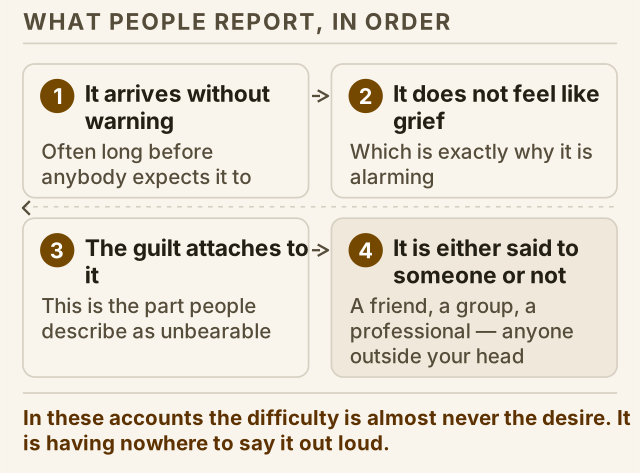
The guilt is the actual problem
Almost everyone who describes widow’s fire spends more time describing the shame than the desire.
The reasoning underneath it is usually some version of: if I loved him, I should not want this. Or worse, the fear that other people would take the feeling as evidence that the marriage was less than it looked. Widowed people are already being watched for signs of impropriety, and they know it.
Two things are worth saying plainly. Desire is not a statement about the dead: not a comparison, not a betrayal, not a vote. And a body responding to loss with a demand for life is a very old human pattern, not a defect in your character.
The second thing is quieter: this is close to unsayable. It cannot be raised with adult children, rarely with the people who bring casseroles, and often not even in a grief group, where it is usually the one subject nobody starts. That silence is why every person who feels it believes they are the only one.
What do people actually do about it?
There is no correct response, and the options people describe are unglamorous.
Some wait it out, on the reasonable theory that a feeling this loud will not stay this loud. Some go looking for company and find that a first date was not what they wanted after all. Some find that what actually helps is unrelated to sex: hard physical exercise, swimming, long walks, a massage, a dog that leans on them. Touch answers touch-hunger more directly than anything else on the list.
Some date, and some sleep with someone, and some find that it helped and some find it made the house feel emptier afterwards. Both outcomes are reported often enough that neither can be predicted for you.
Two practical points, without moralising. If you act on it, the ordinary safety rules apply exactly as they do at any age — meet in public, arrange your own transport, tell one person where you are, and see widow and widower dating sites for why widowed people are targeted by fraud more than most. And be honest with anyone you involve about what this is, because the person on the other side of it is entitled to know whether they are being met or borrowed.
When does widow’s fire belong with a professional?
Most of what is described on this page eases on its own. Some of it does not, and the line is worth naming.
If the feeling has turned into behaviour you cannot stop, if it is putting you at risk, if it is bound up with drinking, or if you cannot function — not sleeping, not eating, not able to work, unable to imagine a future — that is a conversation for a doctor or a grief counsellor rather than an article. We are editors, not clinicians, and saying so is more useful than pretending otherwise. If you are in immediate danger in the US, 988 reaches the Suicide and Crisis Lifeline.
Where to go next
If the question underneath this one is whether you are ready to date at all, that is covered in dating after losing a spouse. If what you are actually describing is the ache of an empty house rather than desire, widow loneliness is the closer page, and life as a widow or widower covers the ordinary weight of the day underneath both.
We publish no figures on this page, because we have not found a primary source that measures how many widowed people experience widow’s fire or for how long. What we do and do not print is explained on our statistics page. Nothing appears in a contributor’s name on this site until they have confirmed it word for word, with the date of the interview shown — which is why there is no personal account here yet.