Widow widower dating is a strange market to shop in. The search results promise a dedicated world; what actually exists is a handful of small specialist sites, a much larger set of mainstream over-50 platforms, and a lot of people meeting through communities that have nothing to do with dating at all.
This page maps the landscape honestly. We take no payment from any platform, we do not rank them for money, and where we do not have verified information — pricing, in particular — we say so instead of guessing.
What kinds of widow widower dating sites actually exist?
Three kinds of platform, plus a fourth thing that is not a platform at all.
1. Widow and widower specific sites and apps. Built for one situation, usually small, usually run by tiny teams. The appeal is obvious: you never have to explain the basic fact about yourself, and nobody treats it as a warning sign. The catch is density. A niche site with a modest national membership can be almost empty within an hour’s drive of a small town.
2. Mainstream platforms for the over-50s. Larger membership, more activity, and a substantial proportion of members who are widowed even where the site never mentions the word. Many allow marital status filters or let you say it in your profile. These are where most people over 60 actually end up, simply because there are people on them.
3. General dating apps. Not aimed at this at all, but not hostile to it either. Better in cities, worse for anyone who dislikes swiping, and the place where the mismatch of expectations between age groups is most visible.
Then there is the fourth category that never appears in a list of dating sites, which is where a great deal of this actually happens: Facebook groups for widows and widowers, forums and subreddits such as r/widowers, in-person grief groups, faith communities, classes, volunteering, and friends making introductions. None of them charge anything.
Why is the specialist corner smaller than it looks?
Because a good deal of what ranks is not an active service. Search for a widow dating site and you will find a dozen brands, and the picture thins out quickly when you look closer.
Some of what appears is app-store listings rather than active services. White-label sites are the same software under several names, sharing one member pool, and several of these brands are that. Some are affiliate review pages that exist to rank, not to help, and the “top 10” ordering reflects commission rather than quality. And some are real, small, sincere operations run by one or two people, which is admirable and still means fewer members.
None of that makes the category worthless. It means you should judge any specialist site on density before anything else. Density is the number of active members near you, at your age, right now, and it tells you more than any brand does.
The pool is lopsided, and that is worth knowing first
Whatever platform you choose, the underlying population is uneven, and it explains a lot of the frustration on both sides.
Analysis by the National Center for Family & Marriage Research at Bowling Green State University found that in 2022, 29.5% of U.S. women aged 65 and older were widowed, compared with 10.3% of men that age. Roughly speaking, there are far more widows than widowers in the age band where most of this dating happens.
Any site aimed at widowed people is working with a pool where women heavily outnumber men.
Who these figures describe
- Women 65 and older / Men 65 and older — U.S. adults aged 65 and older, by sex, currently widowed
Source: National Center for Family & Marriage Research (NCFMR), Bowling Green State University — Family Profile FP-24-04, 2022. See how we check numbers.
Show these numbers as a table
| Group | Value | Who it describes | Source |
|---|---|---|---|
| Women 65 and older | 29.5% | U.S. adults aged 65 and older, by sex, currently widowed | National Center for Family & Marriage Research (NCFMR), Bowling Green State University — Family Profile FP-24-04, 2022 |
| Men 65 and older | 10.3% | U.S. adults aged 65 and older, by sex, currently widowed | National Center for Family & Marriage Research (NCFMR), Bowling Green State University — Family Profile FP-24-04, 2022 |
Timing is concentrated too. The U.S. Census Bureau, using 2016 data, found that among Americans widowed in the previous 12 months, 71% of men and 69% of women were aged 65 or older, while people 65 and over made up only 19% of the population aged 15 and over.
The practical consequences are blunt. Widowed men on these platforms receive a lot of attention quickly, which flatters some of them into behaving badly and makes it harder to tell genuine interest from volume. Widowed women face a crowded field and more competition for fewer men, and are also the group scammers target hardest. If you are widowed under 55, the specialist sites will feel elderly, and general apps may serve you better.
Are widow dating sites free or paid?
The usual pattern across this category: registering is free, building a profile is free, browsing is free or partly free, and replying to a message is not.
That is not necessarily a scam — running a platform costs money and advertising alone rarely covers it. But it does mean the free tier is often designed to show you exactly enough interest to make paying feel urgent. A profile receiving warm attention within minutes of going live, on a site you have not paid for, deserves suspicion rather than excitement.
The genuinely free routes are the community ones: Facebook groups, forums, in-person groups. They are not matching services and they do not pretend to be. Many people use both — a community for company and comparison, a platform for actual dating.
A note on pricing
We are compiling a price and feature index for the main platforms in this category, checked directly rather than copied from other review sites, with the date of each check shown. It is not finished, and we would rather publish nothing than publish numbers we have not verified. Prices, trial lengths and renewal terms in this market change frequently, so treat any figure you find elsewhere — including on the platforms’ own marketing pages — as needing confirmation at the checkout screen.
What should you ask before you pay anyone?
A short list that removes most of the regret:
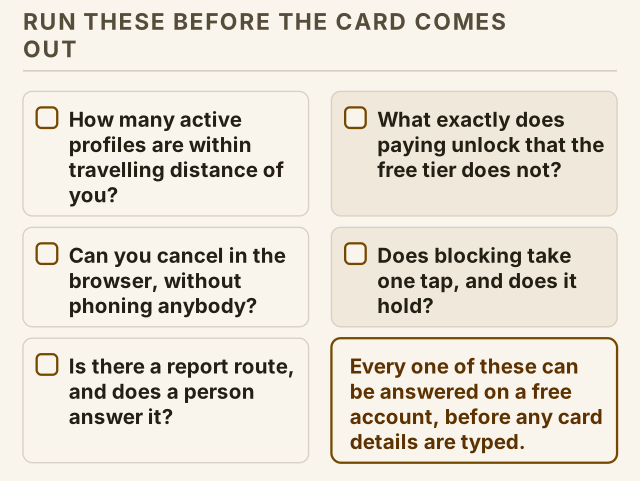
- How many members are within 25 miles, in my age range? Search before you subscribe. If the site will not show you, that is the answer.
- What does the price become after the introductory period? The renewal rate, not the headline.
- Does it auto-renew, and how do I cancel? Find the cancellation route before you enter a card. If it is hard to find now, it will be harder later.
- Can I message at all on the free tier? If not, assume every early message is bait until proven otherwise.
- Are profiles verified in any way? Photo checks and identity checks are imperfect, but their total absence tells you something.
- Is there a block and report function that works? Test where it is.
- What happens to my data if I delete the account? Especially photographs.
Safety, stated plainly
Widowed people are a favoured target for romance fraud, and the reasons are not subtle: the loss is often public, the loneliness is real, and there may be insurance or pension money in the background.
Romance fraud here means an approach that manufactures intimacy quickly and then asks for money, and the pattern is consistent enough to be worth memorising. Intense affection very early. A story that explains why they cannot meet or video call, such as an overseas contract, a military posting, an oil rig or a hospital. Rapid movement off the platform to private messaging. A crisis, then a request for money, often small at first. Anger or renewed devotion when you hesitate.
Three rules that cost nothing: no video call, no relationship. No money, ever, for any reason, to anyone you have not met. And tell one friend or adult child what is going on, because the isolation is the mechanism the fraud depends on.
Ordinary safety applies as well. Meet in public, in daylight, arrange your own transport, and tell someone where you will be. This is not advice for the young.
How much should your profile say?
Say you are widowed. Not in the first line, not as the headline, but somewhere plain and early: for example, “widowed in 2022” in the about section does the entire job.
Two reasons. It filters out people who cannot handle it, at no cost to you. And it stops the fact becoming a revelation on date three, which is when it starts to feel like something you were hiding.
What not to do: build the whole profile around the loss, use a photograph that includes your late spouse, or open with the story. You are advertising a life, not a history. One line of fact, then everything else about who you are now.
When the platform is not the problem
If every attempt ends the same way — a good first meeting followed by a wall — the issue may be timing rather than the site. That is not a failure, and it is not permanent. The readiness question is covered in dating after losing a spouse, which is also the place to start if the guilt is the loudest part.
If you are the person dating someone widowed rather than the widowed person, dating a widow and dating a widower cover what tends to happen next. For definitions and what changes on remarriage, see widow and widower. And for the ordinary weight of the day before any of this, life as a widow or widower.
Every figure on this page is listed with its source on our statistics page. We take no affiliate commission from any platform named or described here.