Dating a widower and feeling second best is the most common private complaint in this whole situation, and the one people are least willing to say out loud. It sounds like jealousy of a dead woman. Usually it is not. It is a reasonable response to standing inside a relationship where one of the two histories is finished, sealed and beyond argument.
Dating a widower and feeling second best refers to the sense that you come second to a marriage that cannot be argued with — a feeling produced by how that marriage ended rather than by where you stand with him. This page is about what that feeling actually is, what shifts it, and how to tell the difference between a feeling a relationship can absorb and a position that is not going to improve.
Why does dating a widower make you feel second best?
Because a marriage that ended in death did not end in disappointment. There is no list of faults to compare against, which is exactly what makes the comparison unfair and unwinnable.
An ex-wife comes with a story about why it stopped. A late wife comes with a story about how it was interrupted. Divorce leaves a cautionary tale; death leaves a marriage frozen at its last good version, and nobody — least of all him — is going to start listing its problems now.
The environment reinforces it. Her photographs are on the wall because they were always on the wall. Her family are still his family. The calendar keeps producing her birthday and the wedding anniversary. Nobody holds a memorial service for a divorce, and no one asks a divorced man’s new partner to be gracious about the woman before her.
So you are not imagining the asymmetry. You are just misreading what it means. The asymmetry is about how the first marriage ended, not about where you rank.
What are you actually competing with?
It is almost never her. What you are competing with is a settled arrangement — a household that ran a certain way, a role with a shape, and a version of him that came with a built-in second person.
That distinction matters because the two problems have different solutions. If the problem were her, nothing could be done. Because the problem is an arrangement, things can be done, and they are dull practical things rather than emotional breakthroughs.
Widowhood is common enough that this position is not unusual, though it is more often women who occupy it. The National Center for Family & Marriage Research at Bowling Green State University reports that in 2022, 29.5% of U.S. women aged 65 and older were widowed, compared with 10.3% of men that age. One consequence, and this is the editors’ reading rather than a finding: a widower is a comparative rarity among his own friends, and is often steered back towards a relationship faster than he can manage — by his children, by her friends, by everyone with an opinion.
Which means some of the pace you are living inside was set by other people, and some of the comparison you are feeling is being made by them rather than by him.
The comparison is designed so that you lose
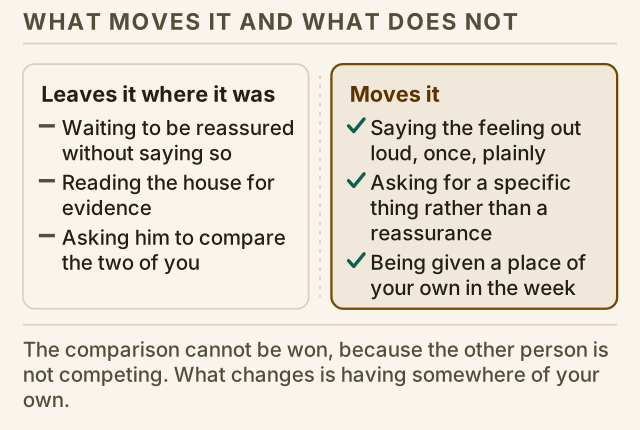
You cannot win a ranking against someone who cannot lose ground. She will never be short-tempered again, never forget a birthday, never handle his mother badly. You will do all three by Christmas.
That is the whole trap. Any attempt to compete on the terms of the comparison confirms the terms. Every time you ask for reassurance about the ranking, you make the ranking the subject of the relationship.
The way out is not to win it. It is to stop conceding that a ranking is the right question. Two relationships, in different decades, with different people, doing different jobs. There is no scoreboard on which those are the same event.
What actually helps when you feel second best?
Concrete changes, such as a room that gets redecorated, a holiday that is new, a Sunday that belongs to the two of you.
The pattern under all of those is additive rather than subtractive. Nothing has to be removed for you to be present. Additive change is new things existing — territory, routines and decisions that never had her in them, and therefore cannot be compared.
- New rather than replaced. A restaurant neither of you has been to beats the one he always went to with her, whether or not he still likes it.
- A standing place in the week. Not availability. A slot that is yours whether or not something better appears.
- Being told before, not after. He tells you the anniversary is coming and what he wants to do about it. You find out from him, not from a mood.
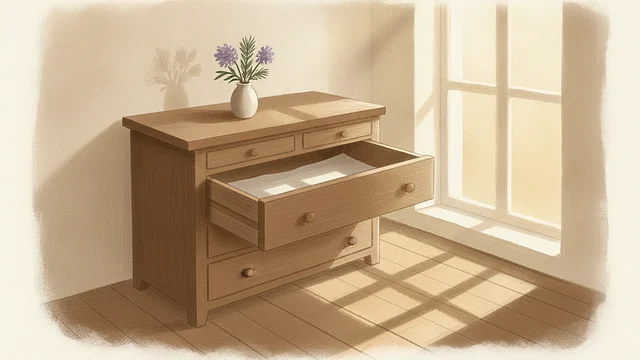
- Your things in the house. A drawer, a mug, a shelf. Small, unromantic, and the most reliable measure there is.
- Being named to other people. You do not need him to declare a ranking to you. You need him to describe you accurately to a colleague.
- A future stated in sentences. Not proof, not a promise. A sentence about next spring that includes you in it.
None of this is a ceremony. It accumulates, and the accumulation is what the feeling responds to — the second-best feeling is, in practice, a shortage of evidence rather than an excess of grief.
Note on how this page is written. Marten Elder, the widower who contributes to this site, appears here only in confirmed, dated quotes. We have none from him on this subject, so no quote is printed in his name. Nothing above is presented as testimony from readers, because we have not collected any.
What does not help?
Asking him to prove a ranking. There is no answer that survives being asked twice.
The mechanics of it are worth spelling out. If he says you are the greater love, he has said something he cannot fully mean and you will not fully believe, and you will need it again in a fortnight. If he says the marriages are not comparable, that is true and it will land as an evasion. The question has no correct answer, so it produces resentment on one side and hunger on the other.
Also unhelpful, and all of them tempting:
- Asking for photographs to come down. A man who removes her from the walls to keep you calm has not made room; he has made a concession, and he will remember it.
- Reading her things. Letters, messages, her social media, the eulogy. It never once produces the reassurance it promises.
- Auditioning for her role. Cooking what she cooked, keeping the house the way she kept it, managing his children the way she did. It buys approval and costs you the position.
- Asking his friends how you compare. They will be kind and it will help for a day.
- Testing him on dates. Manufacturing a crisis on her anniversary to see who he chooses is a question you already know the answer to, asked in the cruellest available form.
When should you say it out loud?
Early, plainly, once. Not as an ultimatum and not at midnight.
Say the concrete version, not the feeling. For example, “I have never been to your house” is workable. “I feel like a stand-in” is true but gives him nothing to do except reassure you, which is the loop you are trying to leave. Name one fact, say what you would prefer instead, and stop talking.
Then judge the category of the reply rather than its warmth. A man who is grieving and willing gives you an awkward, partial answer with something in it that could actually happen — a date, an introduction, an admission of what he is afraid of. A man who is not gives you a reply about grief in which nothing could ever happen, no matter how long you wait.
Once is the important part. Said once, it is information. Said monthly, it becomes the subject of the relationship, and you will both start believing the problem is your insecurity. The direction of travel over six months tells you more than any single conversation: are there more of the concrete things than there were, or exactly the same number?
When the feeling is being manufactured
Feeling second best because of the situation is ordinary. Being made to feel second best is a different matter, and it is not grief.
The version that matters is comparison aimed at you — for instance, how she cooked it, how she kept the house, how she handled his children, delivered as instruction rather than memory. Memories are offered; standards are applied. If you cannot tell which is happening, notice whether it leaves him sad or leaves you smaller.
The other manufactured version is concealment. Concealment is the decision to keep the relationship out of everyone’s view while explaining that as grief. If after a year you have met nobody, never stay at the house, and every question produces an explanation about grief that would work equally well next year, the feeling is not a misperception — it is an accurate reading of your position. That case is sorted in detail in widower red flags, and the mirror image, what a serious man does instead, is in 5 signs a widower is serious about your relationship.
If you are the widowed one reading this
The same feeling runs in the other direction, and it gets far less sympathy: the worry that you are quietly making someone feel like an understudy while you are still working out who you are without your wife or husband.
Two things are usually enough, and neither requires you to grieve less. Say what is happening rather than leaving people to interpret your silences — a sentence in advance about a bad week costs nothing and prevents a fortnight of guesswork. And add something new to your life that the new person is in from the start, instead of fitting them into arrangements that were built for someone else.
What is not required: taking down photographs, removing the ring on a schedule, or performing a stage of grief you have not reached. If the question is what to do about the ring itself, marrying a widow or widower covers the practical decisions, and what widowed means in a relationship covers what the word does and does not say about availability.
When it is bigger than a relationship problem
If the second-best feeling has stopped being an occasional ache and is now organising your sleep, your friendships and your sense of yourself, that is a conversation for a counsellor rather than an article.
The same applies on his side. Grief itself is not an illness, and most of it needs time rather than treatment. But prolonged grief disorder was added to the DSM-5-TR by the American Psychiatric Association in 2022: grief that stays at full intensity and keeps someone from ordinary functioning is something a clinician can assess — and any thought of self-harm or suicide is a reason to contact a doctor the same day, or in the United States the 988 Suicide and Crisis Lifeline, rather than something to manage privately as a couple. We are editors, not clinicians, and that line matters more than anything else on this page.
Where to go next
For the wider picture of what dating a widowed man involves, start at dating a widower. If you are the widowed one, life as a widow or widower is the ground underneath all of it. The timing question — how long anyone should wait, from either side — sits on dating after losing a spouse. Every figure quoted here is listed with its source and date on our statistics page.