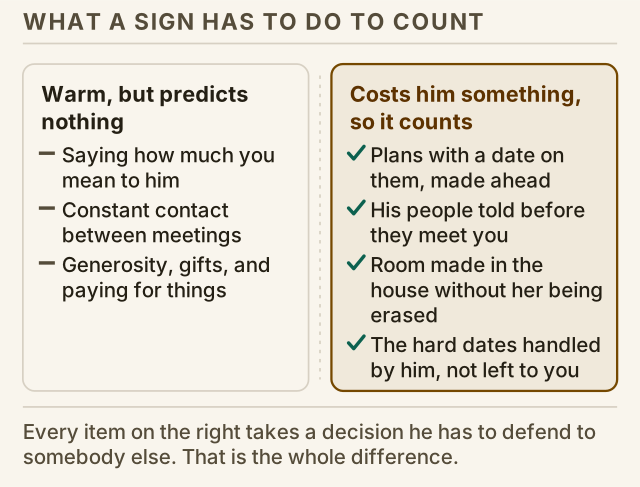
The 5 signs a widower is serious about your relationship are not the ones most people watch for. Warmth, declarations and intensity are all cheap and all available to a man who has no intention of building anything. What is expensive is logistics: telling people, giving up a Saturday, putting your name in a diary that other people can see.
The 5 signs a widower is serious about your relationship are logistical rather than emotional: his planning range extends, his people are told before they meet you, the house makes room without erasing her, he handles the hard dates himself, and he names what this is first. This page is about the expensive things. It assumes you already like him and are trying to work out whether this is going somewhere, without asking him to prove it by grieving less.
1. How far ahead does he plan?
Further than he could a few months ago — the range extending is the signal, not any single plan. Grief shortens the range of a person’s planning. In the early period many widowed people genuinely cannot picture next month, and a man saying “I can’t think that far ahead” in month three is usually telling the truth.
So the sign is not one plan. It is that the range extends. Something in a diary a few weeks out, then something with a ticket attached, then something that requires another person to be told you exist — a wedding, a holiday, a Christmas. The direction of travel is the whole signal.
What does not count: enthusiastic plans made at midnight that never acquire a date. A calendar is a commitment. For example, a conversation about how nice it would be to go to Italy is not.
2. Were his people told before they met you?
They were, if he is serious — meeting his friends and family matters less than what happened before the meeting.
Being introduced is being told about in advance: he told his sister about you, and now here you are. Being run into is the other version, where you happen to be present when someone arrives and are described as a friend. The second version can happen once by accident. Twice is a decision.
Adult children are the hardest case and deserve some patience. Telling them is genuinely frightening for a widower, and their reaction is often about the parent they lost rather than about you. But frightened is not the same as unwilling. A serious man tells you what he is afraid of and when he intends to do it anyway. He does not leave the subject permanently unopened and hope you stop noticing.
3. Does the house make room without erasing her?
It does, in small additive ways rather than by taking her photographs down. People expect this sign to be about photographs coming down. It usually is not, and asking for that is a poor trade — a man who removes her from the walls to keep you happy has not made room, he has made a concession he will resent.
The real version is additive. Additive means your things arriving rather than hers leaving, such as a shelf, a drawer, a mug you use, your shampoo in the bathroom, eventually a key. These are small, unromantic and enormously informative, because each one is a piece of territory in a house that has been a shrine-shaped problem for him since she died.
The failure mode to watch is not photographs but access: a house you visit and never inhabit, always by arrangement, never with your things in it. After a year of that, the message is not grief.
4. Does he handle the hard dates himself?
A serious man tells you in advance that one is coming and says what he wants to do about it. Anniversaries, birthdays, the date of the diagnosis, the wedding anniversary that keeps arriving anyway. These are unavoidable and they are not a problem.
What tells you something is who does the work around them. In the version that is going well, he tells you in advance that a date is coming, says what he expects to be like, and says what he wants — to be alone with it, to have you there, to do something ordinary and not discuss it. You then know where you stand and can behave decently.
In the version that is not going well, the date arrives unannounced, he disappears into it, you spend two days trying to work out what you did, and afterwards nothing is explained. The difference is not how much he is grieving. It is whether he is treating you as a participant in his life or as an audience for it.
5. Who names what this is, first?
He does, if he is serious. At some point someone has to say what the relationship is, and one of the more reliable signals in this whole subject is who says it.
Serious looks like him defining it — to you, and then to somebody else. Introducing you to a colleague without hunting for a noun. Consider a direct question answered directly, including when the answer is complicated: I want this, and I am not ready to talk about living together yet. That is a real answer. It has a position in it.
Unserious looks like permanent ambiguity, maintained gently. Permanent ambiguity is affection with no content: every attempt to define the relationship is met warmly, and you leave the conversation reassured but knowing nothing new. If you cannot repeat back what he said the next day, he did not say anything.
What proves nothing
Some of the most emotionally powerful moments in this kind of relationship carry no predictive information at all.
- Telling you about her. It is intimate and it is generous. It is not a commitment.
- Saying he loves you. Especially early. Widowers are often lonely in a way that produces sincere, enormous feeling very fast.
- Sex. Whatever else it does, it does not settle this question.
- Crying with you. Being trusted with grief is not the same as being given a place in a life.
- Giving you something of hers. People read this as the ultimate signal. It is a gesture about her, made in the present tense, and it tells you about his relationship with the loss rather than his intentions towards you.
None of that is worthless — it is closeness, and closeness is the point. It simply does not answer the question you came here with.
If only two of the five are true
That is the most common situation, and it is usually a question of time rather than character. The useful move is not to score him but to check the direction: are there more of these than there were six months ago?
If the answer is yes, slowly, then this is an ordinary relationship with an unusual history. If the answer is that nothing has moved and every attempt to discuss it becomes a conversation about your patience, that is a different problem, and it is covered in widower red flags.
Where to go next
For the wider picture of what dating a widowed man involves, see dating a widower. If you want the timing question answered from his side rather than yours, dating after losing a spouse is the page. And for what the word itself means on forms and after a remarriage, widow and widower has the definitions.