Searching for widower red flags usually means one of two things has happened: something specific unsettled you and you want to know whether it counts, or nothing specific has happened and the relationship simply will not come into focus.
This page sorts the behaviour into three groups — what is grief, what is a warning, and what is neither — and gives you the test that tells them apart. It is written by editors, and it does not treat a grieving man as a defective one. Widower red flags are the behaviours that persist and do not move: concealment, comparison used to correct you, and being needed without being given a relationship.
How do you tell ordinary grief from a red flag?
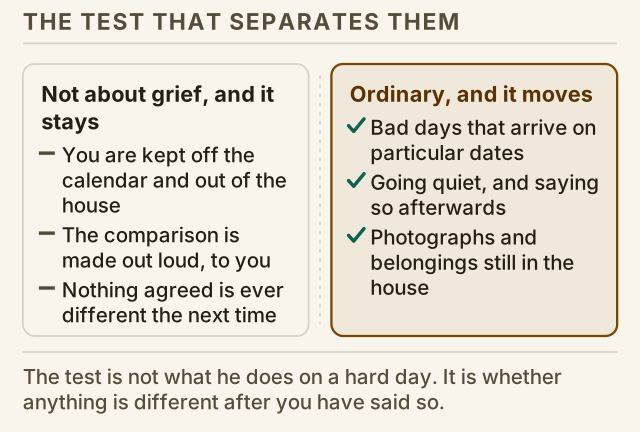
By three things around the behaviour rather than the behaviour itself, which looks identical on a Tuesday night either way: whether it is a pattern, whether it is moving, and what happens when you say it out loud.
Is it a pattern or an episode? Going quiet on the anniversary of her death is weather. Going quiet every time the relationship becomes real is a climate.
Is it moving? Grief changes shape over months. A man who could not talk about the future in March and can in September is grieving. A man in exactly the same position two years apart is not stuck in grief; he has an arrangement that suits him.
What happens when you say it out loud? This is the one that decides most cases. Name one concrete thing — not a feeling, a fact — and watch. If he engages with it, even badly, you are negotiating. If every raised subject becomes evidence of your insecurity, your impatience or your failure to understand what he has been through, that is not grief speaking. That is a way of never having the conversation.
Which widower red flags are not red flags at all?
Most of the ones about objects and memory. A great deal of what gets called a red flag online is simply what a life with a first half looks like.
- Her photographs are still up. Including in the bedroom, at least for a while. Photographs are not a ranking.
- He still wears the ring, or moved it to the other hand, or keeps it in a drawer he opens sometimes. There is no etiquette here that binds anyone.
- Her clothes are still in a wardrobe. Sorting a dead person’s belongings is brutal and there is no schedule for it.
- He cries, unexpectedly and at nothing. A song in a supermarket, a date on the calendar, a smell.
- He talks about her. Frequently. By name. This is usually a good sign, not a bad one — the men who cannot say her name at all are the harder proposition.
- Her family are still in his life. They were his family too. Their presence is not a competing loyalty.
- He is still in the same house. Staying is not avoidance and leaving is not health.
None of these predict anything about how the relationship will go. What predicts it is whether there is room for you as well — and room is a matter of calendars, keys and introductions, not of what is on the mantelpiece.
The flags that matter, in three families
Concealment
The most reliable warning sign in this entire subject is a relationship that exists only in private.
Some discretion early is reasonable, particularly where there are children or a small town involved, and a widower has genuine cause to fear the commentary. But discretion has a shape: it is discussed, it has a reason you can restate, and it has an end you can both name.
Concealment is none of those things. Months pass, you have met nobody, you have never been to the house, plans are always at your place, and any question about it produces an explanation about grief that would apply equally well next year. Grief does not require secrecy. Secrecy is a decision he is making about you, and the usual reason is that something in his life has not been told about you either.
Comparison used as a correction
Occasional comparison is unavoidable and mostly harmless. He was married for decades; you will remind him of things.
The version that matters is comparison aimed at you. For instance: how she cooked it, how she kept the house, how she handled his children, how she would have reacted. Delivered as instruction rather than memory, it is a way of telling you that the role is fixed and the previous occupant set the standard. This one rarely softens on its own, because the man doing it usually does not experience it as unkindness — he experiences it as describing the correct way to live.
A useful distinction: memories are offered, and standards are applied. If you cannot tell which one is happening, notice whether it makes him sad or makes you smaller.
The arrangement where you are staff
The third family is the quietest and the hardest to see from inside, because it feels like being needed.
The staff arrangement is the one where he is not looking for a partner at all. He is looking for the function his wife performed — the meals, the appointments, the reminders, the social organising, the emotional interpreting of his own children to himself. You are busy, useful and constantly in touch, and none of it is reciprocal. Asked directly what this relationship is, he says he is not ready to think about that.
The tell is the direction of the effort. In the first year of an ordinary relationship both people are working. If you can list what you have taken on and struggle to name one thing he has taken on for you, the arrangement is not a relationship yet, whatever the affection in it is.
What is the red flag that is not on most lists?
Money. It is uncomfortable to raise, so most pages skip it.
Watch for a relationship that becomes financially entangled quickly, such as a loan, a business, joint payments, or being moved into the house before anything else has been settled — particularly where the widowed party is you rather than him. Widowed people are targeted for fraud precisely because loss is public and insurance or pension money is often in the background, which is covered in more detail on widow and widower dating sites. The rule that costs nothing: no money, in either direction, before the relationship has a shape everyone can see.
What do you do when you have spotted one?
Not a list of ultimatums. One conversation, held badly if necessary.
Pick the most concrete version of the problem you have — for example, “I have not met your daughter and it has been eight months”, not “I feel like a secret”. Say it once, plainly, without a case attached. Then say what you would like instead, with a timeframe that is yours rather than a demand on him.
Then listen to the category of the answer. A man who is grieving and willing will give you a difficult, awkward, partly unsatisfying reply that contains a plan. A man who is not will give you a reply about grief with nothing in it that could ever happen.
If it is the second answer, you have not misread anything, and no amount of patience converts one into the other. That is not a judgement on him; some people are not available, for reasons that are entirely real. It is simply information about whether this can be your life.
And if what you actually need is help rather than a decision — if this is eating your sleep and your friendships — that is a conversation for a counsellor, not an article. We are editors, not clinicians.
Where to go next
The mirror image of this page, written for what good looks like, is 5 signs a widower is serious about your relationship. For the wider picture of what dating a widowed man involves, see dating a widower, and for the timing question from his side, dating after losing a spouse. If you are the widowed one in this pairing, life as a widow or widower is the ground floor underneath all of it.