Searching for the consequences of sleeping with a widower usually means it has already happened, and something afterwards did not go the way you expected. He went quiet. He apologised for something you did not experience as an offence. Or he was fine, and you were the one lying awake.
The consequences of sleeping with a widower are mostly emotional and mostly delayed: guilt that surfaces a day or two afterwards, aimed at his marriage rather than at you, and easily misread as rejection. This page describes what tends to follow, why it happens, and the one short conversation that removes most of the damage. It is written by editors. It is not therapy, and it treats grief as an experience rather than a condition.
Why does a widower go quiet after sleeping together?
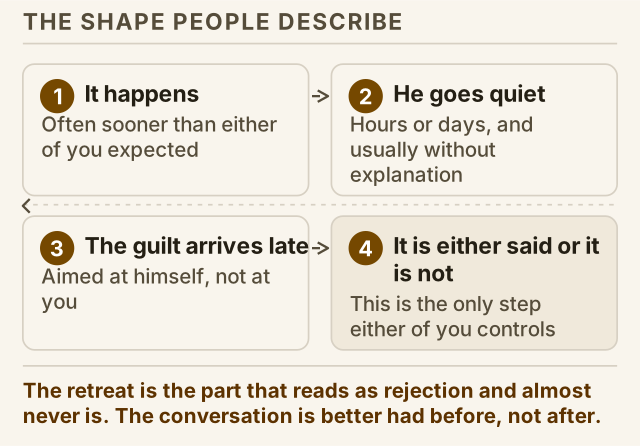
Guilt often arrives a day or two after, not during. That timing is the single most useful thing to know, because it breaks the obvious explanation.
In the moment, most people are present. The reaction comes later — for example, in the car, at work, at three in the morning — and by then it has attached itself to whatever is nearest. Frequently that is you, because you are the new fact in his life and the only part of the situation that can be talked to.
What it looks like from the outside is a man who was close on Saturday and unreachable by Tuesday, with no event in between to explain the change. It reads as regret about you. It is more often a private argument he is having with himself, held at a distance because he does not want you to watch it.
The practical consequence is that the two of you are working from different clocks. You are waiting for a message about the evening. He is somewhere behind that, deciding whether being alive and wanting things is a betrayal. Neither of you is being unreasonable, and neither of you can see the other’s timeline.
What does the retreat not mean?
It is rarely about attraction, and almost never about you. That is worth stating flatly, because the assumption in the other direction causes most of the wreckage in the fortnight afterwards.
- Not a comparison. Guilt is usually loyalty, not preference. A man in the middle of it is not ranking two people; he is discovering that he can be happy without her present, which is a harder thing to absorb than most descriptions of grief admit.
- Not a verdict on the relationship. A retreat in the week after is weak evidence of anything. What he does within a fortnight tells you far more than what he does on the Tuesday.
- Not a sign he moved too fast. Sometimes it is. Often the same reaction would have arrived at any point, because there was never going to be a date on which this stopped feeling significant.
- Not something you can prevent by being more careful. You can make it discussable. You cannot make it not happen.
The mirror image is also true, and gets less attention: sex proves very little about how serious he is. It is closeness, and closeness is worth having. It is not a commitment, and it does not answer the question of whether you have a place in his life — that question is answered by calendars and introductions, which is the subject of 5 signs a widower is serious about your relationship.
What should you agree before it happens?
One short conversation in advance removes most of the damage. Not a negotiation, and not a discussion of feelings — a practical agreement about what happens if the evening turns.
Three things are worth having settled before they are needed:
Either person can stop, without a reason. Stopping is not a rejection and does not require a speech afterwards. Agreeing this in daylight is what makes it usable at midnight.
A delayed reaction is expected. Consider a man who says on Thursday that he has been struggling since Saturday: that is the agreement working, not the relationship failing. The thing to ask for is not the absence of guilt but the presence of a sentence about it.
Silence has a limit. Not a rule about how he must feel — a plain request that if he needs distance he says so, rather than vanishing. “I need a few days” is a complete message. Nothing is not.
Held before anything happens, this conversation is awkward for about ninety seconds. Held after a week of unexplained absence, it is a much larger conversation with a great deal at stake in it.
What if he does not want sex at all?
The opposite consequence is at least as common as guilt and is discussed far less: nothing happens, for a long time, and neither of you knows how to raise it.
Desire after a spouse dies is unreliable in both directions. Some widowed people are hit by a surge of it that arrives long before they feel entitled to it. Widow’s fire is the informal name for that surge, and it has a page of its own — see what is widow’s fire. Others lose it completely, sometimes for years. Both are ordinary, and grief is not the only thing in play: other things, such as exhaustion, medication, illness and age, occupy the same territory, and a man in his seventies is not living in the same body he had at forty.
The editorial position here is simple. Absence of sex is not a diagnosis of the relationship, and it is not a problem you can solve by being more available or more patient in silence. What matters is whether it can be named without the conversation collapsing. A pause that both of you have discussed is a shared situation. A pause that cannot be mentioned is a different problem, and the subject is not really sex.
If the loss of desire is distressing him, that is a conversation for his doctor. It is not one for an article, and we are editors rather than clinicians.
Rules you will find online, including the 72-hour one
The internet supplies numbered rules for this because numbered rules are easy to publish and impossible to check.
The 72-hour intimacy rule is a phrase from relationship content — reconnect physically within about three days of a rift — and not a finding from any professional body. It is a particularly poor fit here. A widower’s retreat can run past three days for reasons that have nothing to do with you, and a partner counting hours towards a deadline is not comforting anyone.
The same applies to the waiting periods people are given after a death: a year before dating, six months before anything physical, a season of mourning by the calendar. None of these come from research. They come from etiquette, from family, and from strangers with opinions. Capacity, not the date, is what actually changes.
Who this is happening to
Two figures are worth having in view, because the situation is usually described as though it were rare and eccentric.
The National Center for Family & Marriage Research at Bowling Green State University reported that in 2022, 29.5% of U.S. women aged 65 and older were widowed, compared with 10.3% of men that age. The U.S. Census Bureau, analysing 2016 data, found that among Americans widowed in the previous 12 months, 71% of men and 69% of women were aged 65 or older — an age group that made up only 19% of the population aged 15 and over.
Two things follow. Widowhood at the point where it is most common is an older-adult experience, so a great deal of dating advice written for people in their thirties simply does not apply. And widowed men are the smaller group, which is one reason there is so much less written about what happens to them after a first night with someone new. Pew Research Center also reported in 2025 that widows are less likely than divorced adults to remarry. That is published about women, and Pew gives no equivalent figure for widowers, so it is not a measure of what he will want. The figures we use and where they come from are listed on our statistics page.
How do you tell grief from a pattern?
By repetition and direction. Grief explains a delayed retreat; it does not explain everything, and the distinction matters because “I’m still grieving” is available to anyone as an answer to any question.
A man who withdraws after closeness and then comes back and explains is grieving. A man who withdraws after closeness every time, never explains, and treats each question about it as evidence of your impatience is running a pattern, and the pattern will not be improved by more patience. If the same cycle is still identical a year apart, that is covered in widower red flags.
The other version worth naming: physical closeness that exists only in private, alongside a relationship that never becomes visible to anyone else. Guilt does not require secrecy. Concealment is a separate decision, made about who is allowed to know rather than about her.
When to stop reading and talk to someone
Some of this stops being a relationship question. If he is not sleeping at all, drinking through it, unable to function months on, or saying anything that touches on not wanting to be alive, that is a doctor or a grief counsellor and it is urgent. The same applies to you if this is taking your sleep and your friendships with it.
Prolonged grief that does not shift is a clinical matter, and this page is not equipped for it. Nothing here is a substitute for someone qualified sitting in the room.
Where to go next
For the wider picture of what dating a widowed man involves, start at dating a widower. If you are the widowed one here, life as a widow or widower and the first weeks after a spouse dies are the ground floor. For the timing question from his side, dating after losing a spouse is the page, and how we source what we publish explains why some of the numbers you find elsewhere are not on this site.