People do not search for the horrors of dating a widower because a man has been cruel to them. They search for it after an evening that went badly for reasons nobody can be blamed for: a sister who would not meet your eye, a date in October that emptied the house, a friend who said how lucky he is to have found someone so understanding.
This page is about those parts. It is written by editors, and the honest summary is that the difficulty is mostly social rather than romantic. The relationship is often the easy bit. Everything around it is where the work is. The horrors of dating a widower are, in the accounts people actually give, social rather than romantic: his family, the calendar, other people’s remarks, and a grief of your own that nobody warns you about.
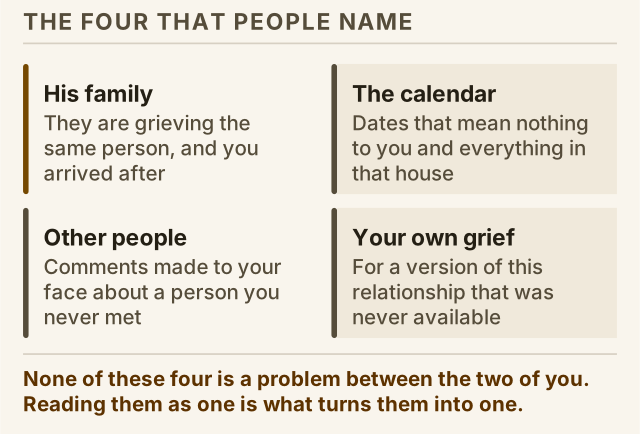
How do you meet a widower’s family when they are grieving too?
Slowly, and without trying to win them: his family lost her as well, and their timetable is not his. That single sentence explains most of the awkwardness in the first year of meeting them.
He has been living with the loss every day and has arrived, at some point, at wanting company again. His mother-in-law has not been on that road with him. Neither have his children, his oldest friends or the neighbours who watched the illness. When you appear, you are the visible proof that his grief has changed shape, and some of them will experience that as news about her rather than news about him.
That produces two failure modes. In the first you are treated as an intruder: politeness with nothing behind it, conversations that stop when you enter, an invitation that never arrives. In the second you are treated as a replacement, which is warmer and worse — for instance, you are handed her chair, her recipes, her role in the family logistics, and expected to be grateful for it.
Neither is really about you, and neither is your job to fix. What helps is refusing both parts. You are not competing for a vacancy and you are not filling one.
Adult children are the hardest case, and usually the relevant one. Among U.S. residents aged 15 and over who were widowed in the previous 12 months, 71% of men and 69% of women were aged 65 or older, according to U.S. Census Bureau analysis of the 2016 American Community Survey. Children of a man widowed at that age are adults, with their own households and their own opinions, which means the difficulty is rarely custody or bedtimes. It is a forty-year-old who feels their mother is being written over.
The editorial position here is simple: their reaction is information about their grief, not a verdict on you, and it is his job to hold the line about your place in his life. Yours is to be decent and unhurried. It is not to win them.
What do you do about the anniversaries and other hard dates?
Learn them and do not compete with them. A hard date is any day that already cost him something before you arrived — an anniversary, a birthday, the date of the diagnosis.
There is a version of the year that already exists before you arrive. The wedding anniversary keeps coming. So does the day she died, the birthday, the last holiday they took, and often a date nobody outside the family would guess — for example, the morning of the scan, the last normal Sunday.
The practical approach is unglamorous. Ask him which dates are hard. Write them down. Then ask, once, what he wants on each: to be alone, to have you there and say nothing, or to do something entirely ordinary. Having asked, do the thing he said rather than the thing that would prove your understanding.
Two mistakes are common in the other direction. One is treating every hard date as a test you can pass by being especially wonderful. The other is being wounded that the date exists at all. The dates are not a referendum on your relationship. They are a fixture list.
What does deserve attention is whether he manages them or you do. A man who tells you a week in advance that Thursday will be bad is doing his half. A man who vanishes for three days every year and never explains it afterwards is leaving you to guess, and guessing is corrosive. That distinction is covered at length in 5 signs a widower is serious about your relationship.
How should you answer other people’s comments?
Briefly, and without defending anything. Most are clumsy rather than cruel; a few are not, and telling them apart decides how much of your day they get.
Clumsy comments are the ones that come from people who have no script. For example: “He’s been through so much.” “You must be very patient.” “It’s lovely that he’s found someone.” They are meant kindly and they land badly, because every one of them describes you as therapy rather than as somebody’s partner.
The unkind ones are recognisable by their direction. They are aimed at your motives, your timing or your right to be there — questions about money, remarks about how quickly this happened, the friend who says her name in a way that is meant to move you down a rank. These are worth naming once, quietly, and then declining to litigate.
There is a demographic reason the commentary exists at all, and it is not flattering to anyone. In 2022, 29.5% of U.S. women aged 65 and older were widowed, compared with 10.3% of men that age, according to the National Center for Family & Marriage Research at Bowling Green State University. Those are shares within each sex, not a count of people, so the honest reading stops at the shares — but it is the arithmetic the “he must have women queuing up” commentary is reaching for. It is still a remark about supply, made about a person, in front of his partner.
The editorial position: you owe nobody an explanation of your relationship, and the shortest true sentence is usually the best one. “We’re happy” ends most of these conversations. What you should not do is defend the timeline. Once you start justifying how many months it has been, you have accepted that somebody else sets the schedule.
Is it normal to be grieving something yourself?
Yes. You are allowed to find this hard without it meaning you should not be here. That sentence is the whole section, and it is the part most pages skip.
Something is being lost on your side too, even in a relationship that is going well. The ordinary version of a new relationship — the blank slate, the first everything, the sense that this person’s life is being built around you from scratch — is not available. His life has a first half, and it is furnished. Grieving the version you expected is not disloyalty and not insecurity.
There is a second, quieter loss if you are the widowed one in this pairing. You are handling his dates and your own, and the two calendars do not align. Nothing here suggests that being widowed yourself makes you better at this. It usually makes it heavier, and life as a widow or widower is the ground floor under that.
The comparison you make yourself is the hardest single item. Not the ones his family make — the ones that arrive at two in the morning, unprompted, about a woman you never met and cannot ask. It does not get better by being argued with. It gets smaller when the relationship acquires enough of its own history to compete on ordinary terms.
How do you tell what is hard from what is a problem?
Hard is not the same as wrong, and the sorting rule matters more than any individual behaviour.
Hard: photographs still up, her family still in his life, tears that arrive at nothing, a bad October, a house he has not left, a ring he has moved rather than removed. None of these predict how the relationship will go.
A problem is a different category: a relationship that exists only in private after months of it; comparison delivered as instruction rather than memory; being useful to him in ways that are never reciprocated; every raised subject converted into evidence of your impatience. Those are sorted properly in widower red flags.
The test between them is movement. Grief changes shape across months. If the same conversation is impossible two years apart, the obstacle is no longer bereavement.
One area to keep out of the romance entirely, in either direction: money. Loans, joint accounts, business arrangements and moving in before anything else has a shape are all worse ideas here than elsewhere, because loss is public and widowed people are targeted for it. We do not give financial or legal advice on this site, and anything involving an estate belongs with a professional rather than an article.
When this needs a professional, not a partner
Grief itself is not an illness, and most of what is on this page is ordinary difficulty. But prolonged grief disorder was added to the DSM-5-TR by the American Psychiatric Association in 2022, so a grief that stays at full intensity and stops someone functioning is something a clinician can name and treat.
There is a line, though, and it is worth naming plainly. Grief that has not shifted at all over a long period, that keeps someone from functioning day to day, or that comes with thoughts of self-harm or suicide, is territory for a clinician — a GP, a bereavement service, a therapist who works with prolonged grief. That is true whether the person in trouble is him or you.
We are editors, not clinicians, and nothing here is treatment advice. If this relationship is costing you your sleep and your friendships, that is also a reason to talk to somebody, and it does not require the relationship to be in crisis first.
Where to go next
For the whole picture of what this involves, start at dating a widower. If the question underneath yours is really about timing, dating after losing a spouse answers it from his side. If it is about what he is likely to want long term, what the word keeps meaning afterwards is set out in widow and widower. Every figure we use is listed with its source and date on our statistics page.