A new widow or widower is someone whose husband or wife has died and who has not remarried, and in the first weeks it means being handed a large amount of administration and a very small amount of capacity, at the same time, by people who mostly mean well. This page is about the first weeks: what genuinely has to happen now, what can wait, and what the people around you are likely to get wrong.
It is written by editors. It is not therapy, and it is not legal or financial advice — where the honest answer is “ask the agency or a qualified adviser”, we say that instead of guessing. Where the line to a professional is, we name it.
What actually has to be done in the first week?
Almost nothing has to be decided in the first week except the funeral, the certificates, and whatever keeps the household running.
That sentence is the most useful thing on this page, because the first week does not feel like that from inside. It feels like a hundred urgent items. Most of them are urgent only in the sense that someone mentioned them.
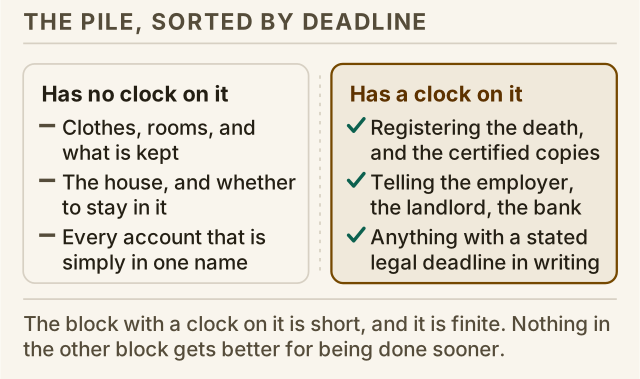
What is actually time-bound is short: registering the death and ordering copies of the certificate, the arrangements themselves, and the ordinary business of food, medication, animals and bills not lapsing. Everything else — the accounts, the house, the car, the clothes, the ring, the question of what you do now — belongs to a later month.
A second thing worth doing early, and it is unglamorous: let one person take the incoming calls. Repeating the sentence to every caller is one of the most draining parts of the first week, and it is entirely delegable.
What can wait, and for how long?
Almost everything can wait months, and the distinction that helps most is between decisions that are reversible and decisions that are not.
| Decision | When | Why |
|---|---|---|
| Funeral arrangements, death certificate copies | First days | Time-bound. Order more copies than you think you need; institutions keep them. |
| Notifying employer, banks, pensions, insurers | Weeks, as you manage | Necessary but not same-day. Each will want a certificate. Ask each one directly what it needs; that is their job, not yours to research. |
| Clothes, personal effects, the wardrobe | Months. No deadline exists | Irreversible. Waiting costs nothing; a wardrobe cleared in week two cannot be undone. |
| Selling or leaving the house | Not in the first year, if it can be avoided | The largest irreversible decision, made at the point of lowest capacity. |
| The wedding ring | Whenever, including never | Nobody else’s business, and there is no convention you are breaking. |
| Anything involving benefits, tax, probate or a pension | With the agency or a qualified adviser | Genuinely outside what a website should be telling you. |
An irreversible decision is one that cannot be taken back — a wardrobe cleared, a house sold, a ring given away. The rule underneath the table follows from that: if a decision cannot be undone and nobody is forcing it, it is not a first-months decision. Six months in you are still the same person, but you are a person who has slept.
Is the way you are functioning a warning sign?
Almost never. A fear that recurs in first-person accounts of early bereavement is that the person is doing this wrong, and it usually attaches to how they are behaving rather than to how they feel.
Consider the ones that come up most often: feeling nothing at all at the funeral, and then breaking down in a supermarket. Losing words mid-sentence. Reading the same paragraph four times. Driving somewhere and arriving with no memory of the road. Sleeping at the wrong times or not at all. Appetite gone or oddly enormous. A physical restlessness with nowhere to put it.
None of that is unusual in accounts of early bereavement, and it commonly eases with time. Numbness is that flattened, unfeeling state, and it gets misread, including by the person in it, as coldness. It is better read as the thing that makes the first fortnight survivable at all.
The other frequent surprise is anger, and often at the person who died. That is common, it is not a betrayal, and saying it out loud to one safe person usually costs less than carrying it.
What do the people around you get wrong?
Mostly they offer help in a form nobody in week one can use. Much of the damage in the early weeks is done by kind people with no script.
“Call me any time.” Easy to offer, hard to act on. It transfers the work of asking onto the person with the least energy in the room.
The explanation. Attempts to make the death make sense — a reason, a lesson, a better place — are for the speaker’s comfort, not yours. You are allowed to say nothing in response.
The comparison. Someone will compare your loss to a divorce, a pet, or a grandparent. Usually they are trying to say they have some idea. It rarely lands.
Disappearing. People who cannot think what to say sometimes vanish entirely, and their silence gets read as indifference. It is more often embarrassment, which does not make it hurt less.
The schedule. The help arrives in a flood and then thins out, often well before the numbness wears off and the house goes quiet. The mismatch between when support comes and when it is needed is one of the most frequently described experiences in first-person accounts of widowhood. We have written about the part that comes after in widow loneliness.
What do you say to a recent widow?
Say you are sorry. Say the dead person’s name. Offer one specific thing at one specific time. Then keep turning up after the sixth refusal.
That is the whole method, and it asks less of the bereaved person than a carefully worded message does. For example, “I’m bringing food Thursday at six, leave the door on the latch” asks nothing of a person with nothing to give. “Let me know if you need anything” asks them to plan.
Three more that are worth knowing:
- Use his or her name in ordinary conversation. The fear that mentioning the person will “remind” them is misplaced. They have not forgotten for a single hour, and the silence around the name is its own loss.
- Do not ask how they are coping in front of a room. Ask in a doorway, or by message, where the honest answer is possible.
- Diarise the second month, and the six-month mark, and the anniversary. Week one is the part everyone remembers. Month four is the part that gets forgotten — and it is the one worth diarising.
What we do not recommend
This is a category with a lot of people selling things to the recently bereaved, and some of it is worth naming plainly.
We do not recommend paying for grief coaching in the first weeks. Grief coaching is an unregulated title, meaning anyone may use it without training or oversight, the quality range is enormous, and the point at which you cannot assess a stranger’s credentials is exactly the point at which you should not be buying their programme. Bereavement counselling through a hospice, a doctor, or a recognised charity is a different thing, and usually free or low-cost.
We do not recommend the stage-of-grief charts as a measure of progress. They were not designed as a schedule for the bereaved, and being at the wrong stage on someone’s diagram is not a condition you can have.
We do not recommend making any decision recommended by a person who contacted you first. Unsolicited approaches after a death are a known pattern, and the FBI’s Internet Crime Complaint Center reports romance fraud against people aged 60 and older every year — note that in those cases it is usually the stranger who claims to be widowed, not the person being targeted. That includes romance fraud months later, which is covered on widow and widower dating sites. Unsolicited contact about your money, your house or your grief deserves no politeness at all.
And we do not print numbers we cannot trace. Several widely repeated statistics about widowhood — an average age, a national headcount, a remarriage rate — failed our source check, so they do not appear here. What we did verify is listed on our statistics page.
You are in a larger group than the quiet suggests
Widowhood is concentrated in later life, and that concentration explains a lot about how isolated it feels at other ages.
The U.S. Census Bureau, in an analysis using 2016 American Community Survey data, found that among Americans aged 15 and over widowed in the previous 12 months, 71% of men and 69% of women were aged 65 or older, while people aged 65 and over made up only 19% of the population aged 15 and over.
Analysis by the National Center for Family & Marriage Research at Bowling Green State University found that in 2022, 29.5% of U.S. women aged 65 and older were widowed, compared with 10.3% of men that age.
Two things follow. If you are older, there are more people in your position nearby than the silence implies, and the difficulty is finding them rather than there being none. If you were widowed at 40, the sense that the available advice was written for someone else is accurate. It mostly was.
Widowers get less of everything
Widowed men are a smaller group and usually a less connected one, and the first weeks show it.
In the first-person accounts we read, practical help tends to arrive for widows and advice tends to arrive for widowers, which is close to the reverse of useful. The recurring complaint from widowers is being told what to do next and not being brought dinner. They are also less likely to know another widower, so there is nobody to check whether what is happening to them is normal.
What tends to work for widowers is oblique rather than confessional — for instance, one friend told directly, something with a task attached, a group organised around an activity rather than around feelings. The general shape of it is in life as a widow or widower.
When should you talk to a professional?
When the weight stops easing at all. Much of what is on this page does ease slowly with time and structure; some of it does not, and the difference is worth stating without hedging.
If months in you are not sleeping or eating, cannot work or run the day, have stopped answering anyone, are drinking to get through the evenings, or cannot picture any future at all, that is a reason to talk to a doctor or a grief professional. Prolonged, disabling grief is something clinicians recognise and treat, and treating it is not a verdict on how much you loved the person.
We are editors, not clinicians. Pointing you towards one is the most useful thing this page can do. If you are in immediate danger in the US, the Suicide and Crisis Lifeline can be reached at 988.
Where to go next
For the longer shape of this — the years, the admin, other people’s advice — start at life after the loss. The part that arrives once the visitors stop is in widow loneliness. If a physical response to the loss has taken you by surprise, that has a name and a page: what is widow’s fire. And if the word itself is the thing you are stuck on, still a widow after remarriage covers what changes and what does not.
Both figures on this page are listed with their sources, populations and dates on our statistics page. We re-check them every six months.