Widow loneliness is the part almost nobody prepares you for, because it does not show up when everyone is watching. The first weeks are crowded: relatives, paperwork, food arriving, a phone that will not stop. The loneliness arrives afterwards, when the callers have gone back to their own lives and yours is still missing a person.
This page is a plain account of what widowed people describe and what they say helped. It is written by editors, it is not therapy, and it says clearly where the line is between an ordinary heavy stretch and something that needs a professional.
Why does widow loneliness arrive late?
The support that follows a death runs on a schedule that has nothing to do with need. It is heaviest when you are numb and least able to use it, and it thins out at almost exactly the point the numbness wears off.
There is a second reason it lands late. Early grief is loud and event-driven — the funeral, the certificates, the bank, the house. Loneliness is what is left when the events stop and the ordinary week resumes for everybody else and does not resume for you.
The result is the complaint widowed people make more often than any other: that people were extraordinarily kind for a while, and then it was assumed the matter had been handled.
Which moments are actually the hardest?
Ask widowed people which moment is hardest and very few say the anniversary. They say an hour.
Usually early evening. The gap between finishing something and eating, which used to be filled with unimportant conversation about nothing. Nobody to tell that the boiler man came, that the neighbour’s daughter had a baby, that the programme you both disliked has been recommissioned.
The absence of a place to put trivial information turns out to be one of the heaviest parts of this, and it sounds absurd when said out loud, which is why people rarely say it. It also explains why company at big events — a birthday, Christmas, a family gathering — often does nothing for the loneliness at all. Those are not the missing hours.
Is company the same thing as routine?
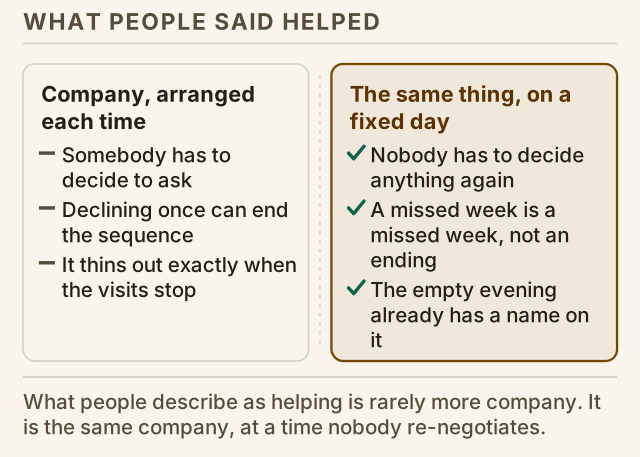
No, and the most useful distinction people draw is between being seen and being expected.
Visitors are company. They arrive, they are kind, they leave, and the house is quieter afterwards than it was before. A standing arrangement is something else: the same class on Wednesday, the same walk on Sunday morning, the same volunteering shift, the same phone call at six. Somebody notices if you do not turn up.
Almost everything people report as having genuinely helped falls into that second category, and almost all of it has a task attached. Work, animals, a choir, a course with homework, a shift somewhere, a group with a fixed day. Sentiment is not the active ingredient. Being expected somewhere is.
The corollary is unwelcome but consistent: “call me any time” almost never gets used. If you are the friend here, do not offer availability. Offer a specific thing at a specific time, and keep offering after the sixth refusal.
What makes widow loneliness worse?
Four things come up repeatedly, and three of them are avoidable.
Filling the diary with the wrong company. Time with people who need managing, or who want the grief performed for them at a manageable volume, is more tiring than an evening alone.
Waiting to be invited. Invitations do stop, usually because someone decided you would not want to come. The blunt fix is issuing them yourself, which is unfair and works.
Letting the house set the schedule. Evenings expand to fill whatever is not booked. People describe leaving the house for something trivial, such as a shop, a walk or a library, as being disproportionately effective for how small it is.
The unavoidable one. Some of it is simply that the person you talked to is dead, and no arrangement replaces that. Pretending otherwise is what makes people give up on the arrangements that do help a little.
You are not as unusual as the silence suggests
Part of what makes this isolating is the sense of being the only one in the room it has happened to. In later life that impression is measurably wrong.
Analysis by the National Center for Family & Marriage Research at Bowling Green State University found that in 2022, 29.5% of U.S. women aged 65 and older were widowed, compared with 10.3% of men that age.
The loneliness feels singular, but the situation is shared by a very large number of women of the same age.
Who these figures describe
- Women 65 and older / Men 65 and older — U.S. adults aged 65 and older, by sex, currently widowed
Source: National Center for Family & Marriage Research (NCFMR), Bowling Green State University — Family Profile FP-24-04, 2022. See how we check numbers.
Show these numbers as a table
| Group | Value | Who it describes | Source |
|---|---|---|---|
| Women 65 and older | 29.5% | U.S. adults aged 65 and older, by sex, currently widowed | National Center for Family & Marriage Research (NCFMR), Bowling Green State University — Family Profile FP-24-04, 2022 |
| Men 65 and older | 10.3% | U.S. adults aged 65 and older, by sex, currently widowed | National Center for Family & Marriage Research (NCFMR), Bowling Green State University — Family Profile FP-24-04, 2022 |
That cuts two ways. If you are older, there are more people in your position within a mile of you than the quiet implies — the problem is not scarcity but that none of you have any way of finding each other. If you were widowed young, you are genuinely in a small group, and the feeling that nobody your age understands is accurate rather than self-pity.
Are widowers lonely in a different way?
Yes, mostly in who they can say it to. Widowed men are a smaller group and usually a less connected one. Widows tend to know other widows; widowers frequently know none, and often have nobody to compare notes with at all.
Friendship among men is more often organised around activity than conversation — consider a round of golf, in which there is no natural moment to say that the evenings are unbearable. Support groups feel wrong to many of them for the same reason. What gets reported working is oblique: something with a task, one friend told directly rather than a room of strangers.
 Illustration
What is a widow support group online good for?
One thing above all: it is available at two in the morning, which is when a good deal of this happens. For anyone who cannot easily get out, or who cannot say any of this to the people they already know, the online versions matter more than they are given credit for.
What exists, roughly: moderated Facebook groups for widows and widowers, some general and some organised by age or by cause of death; forums and subreddits, of which r/widowers is the best known; and video meetings run by hospices, faith organisations and bereavement charities, many of which accept people who were never connected to their service.
How to judge one, since quality varies enormously:
- Is it moderated, visibly? Unmoderated grief groups attract people selling things and people looking for vulnerable strangers.
- Is it private? Check whether posts are visible to anyone who searches your name.
- Does the tone fit you? Some groups are practical, some devotional, some angry. None of these is wrong and only one of them will suit you.
- Are there rules about direct messaging? The good ones restrict it, because widowed people are a favoured target for romance fraud.
- Does it want money? Peer groups should not.
We are compiling a checked directory of these, with the date of each check shown, rather than repeating lists from other sites. It is not finished, and we would rather publish nothing than recommend a group we have not looked at.
When loneliness is something else
Most of what is on this page eases, slowly and unevenly, with structure and time. Some of it does not, and the difference is worth naming plainly.
If months in you are not sleeping or eating, cannot work or manage the day, have stopped answering anyone, are drinking to get through the evenings, or cannot imagine any future at all, that is a reason to talk to a doctor or a grief professional rather than to try harder socially. Prolonged, disabling grief is something clinicians recognise and treat. We are editors, not clinicians, and pointing you towards one is the most useful thing this page can do. If you are in immediate danger in the US, the Suicide and Crisis Lifeline can be reached at 988.
Where to go next
For the wider shape of the first years — the admin, the ring, other people’s advice — see life as a widow or widower. If the loneliness is turning into a question about dating, dating after losing a spouse covers timing, and widow and widower dating sites covers where people actually meet, including the fraud risk that follows widowed people online. If what you are feeling is more physical than lonely, that has a name too, and it is described in what is widow’s fire.
The figure on this page is listed with its source on our statistics page.