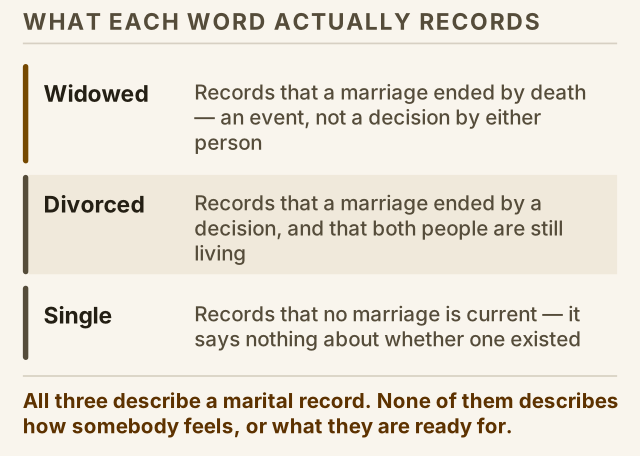
What does widowed mean in a relationship? Widowed in a relationship means the person you are seeing had a husband or wife who died, and has not remarried since. That is the whole definition. It describes how a marriage ended — not how sad someone is, not how emotionally available they are, and not how much room is left for you.
The word gets loaded with a great deal it does not actually carry. This page separates the three questions underneath it: the status itself, what it implies for a new relationship, and how long it lasts.
What does widowed actually mean?
Widowed is a marital status: your spouse died and you have not remarried. It sits on forms alongside single, married and divorced as a separate box, because those four describe different histories, not different levels of worth.
Two things follow, and they are easy to get wrong. A widowed person is unmarried: the marriage ended at the death, so there is no legal obstacle to dating or remarrying. And a widowed person is not a divorced person with a sadder backstory — the previous relationship did not fail, it was interrupted.
That second point is the one that changes how a new relationship starts: there is no decision to defend and no ex to be relieved about.
Widowed vs single vs divorced, side by side
| Status | What it says | On a form | In a new relationship |
|---|---|---|---|
| Single | Never married | Own box; the default if no other applies | No prior spouse in the picture |
| Married | Currently married | Own box | Not available |
| Divorced | Marriage ended by law, not remarried | Own box | A previous marriage that ended by decision |
| Widowed | Spouse died, not remarried | Own box; single if only two options are offered | A previous marriage that ended without a decision |
Checked: 13 August 2026. If a form offers only “single” or “married”, single is the box that fits. That is not a denial of the loss; it is what the form is asking.
Are you widowed if you were never married?
Legally, no. Widow and widower are terms for the surviving husband or wife of a legal marriage, so a long-term unmarried partner does not acquire the status, whatever the relationship was in practice.
This is the point where the definition and the experience part company, and it is worth being straight about it. Consider someone who lived with a partner for thirty years and buried them: they have lost what a married person loses, and have no word for it on any form. People in that position do use “widowed” about themselves. That is an accurate description of what happened to them, even where it is not the answer a government office wants in the box.
If you are dating someone in that situation, the absence of the label does not reduce the loss. What the missing label removes is recognition, not the loss itself.
What does being widowed actually mean for a new relationship?
It means three specific things, and they are not the things the word is usually taken to mean.
The dead spouse stays in the conversation. A late husband or wife comes up — for example, when a story turns out to have started on a holiday you were not on — because thirty years of anecdotes came from somewhere. That is memory doing its ordinary work, not a comparison being run against you.
There was no decision to leave. A divorced partner has an account of what went wrong. A widowed partner may have no such account, because there is no fault to allocate. So the “what happened with your ex” conversation lands very differently, and pushing it asks for something that may not exist.
Grief is not on a schedule that matches yours. It can turn up on an evening that has gone well, which is more disorienting for both people than a bad day would be. The mechanics of that are the same regardless of which of you is grieving.
What it does not mean: that the person is fragile, that they are looking for a replacement, or that they are unavailable until some period of mourning has been served.
How long is someone considered widowed?
Until they remarry. In ordinary use the word stops being applied then, though the fact of having been widowed does not go anywhere and nobody is obliged to stop mentioning a late spouse. We have written that question up separately at are you still a widow if you remarry.
There is no interval after which the status expires. Someone widowed at 40 who never remarries is widowed at 80. Someone widowed last spring is widowed now. The word is not a phase, and it is not a claim about how the person is currently doing.
Certain benefit, pension and tax rules do run on their own fixed clocks, and those clocks have nothing to do with grief or with the language. Those rules are outside what this site covers — a benefits office or a qualified adviser, not a website, is the place to get that answered.
Who is widowed, in numbers
Widowhood is concentrated in older age and, sharply, among women. The National Center for Family & Marriage Research at Bowling Green State University reports that in 2022, 29.5% of U.S. women aged 65 and older were widowed, compared with 10.3% of men the same age.
It is also less common than it once was. The same NCFMR family profile puts the share of all U.S. adults aged 65 and older who were widowed at 20.9% in 2022, down from 35.3% in 1990. The profile reports the shares; it does not explain the shift, and we are not going to guess at the cause here.
The concentration in later life is steep. The U.S. Census Bureau, reporting on Americans widowed in the previous 12 months in 2016, found that 71% of the men and 69% of the women were aged 65 or older, an age group that made up only 19% of the population aged 15 and over.
Two things follow for anyone dating. Widowhood at the ages where those figures are highest is an older-adult experience, and in the same figures a far higher share of older women than of older men is widowed. (Those are shares, not counts; for the direction of the risk itself, Pew Research Center wrote in 2025 that women are much more likely than men to be widowed.) Younger widowhood exists and matters to the people in it; it is simply not where the mass of the numbers sits. Every figure we publish, with its source, sits on our statistics page.
What does the remarriage data actually say?
There is no reliable figure for how many widowed Americans remarry, and we are not going to print one. No primary source we could read separates the widowed from the divorced.
Here is the genuine statistic that gets misused. Pew Research Center found that among U.S. adults whose first marriage ended in divorce or widowhood, 64% of men had remarried as of 2013, compared with 52% of women. Divorced and widowed adults are combined in that measure — it is not a widow remarriage rate, and anyone quoting it as one has read the table wrong.
What can be said directionally: Pew Research Center reported in 2025 that widows are less likely than divorced adults to remarry, and that women are much more likely than men to be widowed. Pew’s sentence is an explanation of why previously married women remarry less often than men. It is not a prediction about any individual woman, and it is not a statement about widowers, who are not the subject of that comparison.
The editorial position on waiting periods
We have no approved figure for how long widowed people wait before dating, because we could not find one on a primary source. The averages quoted around this subject did not survive our source check — we could not trace them back to a survey — so they are not going in.
What we will say is the editorial position, plainly. The timing question has no external answer. For instance, a person can be ready for company and not ready for a relationship, ready at dinner and not ready at 11pm, and neither of those is a warning sign. The sudden return of desire after a loss has a name, and we have written about it at widow’s fire.
The one thing worth watching is not the calendar but the direction: whether someone is going towards a person or away from an empty house. That distinction is the subject of widow loneliness, which is a more useful page than any waiting rule.
Where this page stops
Grief is described here as an experience, not a condition. Where it stops being that — where someone is not functioning months on, cannot get through ordinary days, or is having thoughts of ending their life — the right destination is a doctor or a licensed grief therapist, not a dating article. We do not give clinical advice and would not know how.
Nor do we cover survivor benefits, pensions, inheritance or insurance, all of which turn on the widowed status in ways that vary by scheme and by state.
One more note on how this page is written. Marten Elder, the widower who contributes to this site, appears here only in confirmed, dated quotes; we have none from him on the meaning of the word itself, so there is no quote in this piece. Nothing above is presented as testimony from readers, because we have not collected any.
Where to go next
The practical companion to this definition is the hub itself, dating a widow, which covers what actually changes in the first months. If you are weighing what to say and what to avoid saying, widow finding love again quotes covers which phrasings help and which ones land badly. And if the question underneath yours is about a man rather than a woman, signs a widower is serious is the closer match.
Past the definition, the practical question is usually where people meet and what it costs. Our dating platform pricing index lists each platform’s price with the date we last verified it.