“I will never date a widower again” is a sentence people type into a search box after one relationship, not after a study. It is a verdict reached in a particular kitchen, about a particular man, and then generalised to an entire category of person because the category is the only explanation on offer.
This page takes the complaint seriously without accepting the conclusion. The experiences behind it are real and repetitive enough to have a shape. That shape is worth knowing, because it is also what tells you whether the relationship you are in now is the same story or a different one.
It is the editorial position of this site that the thing people are describing is rarely grief. It is a relationship that stayed permanently private, and grief was the reason given.
What do those relationships have in common?
Concealment, rather than grief. It is the element that keeps recurring in how the complaint is told: not cruelty, not a dramatic betrayal — simply a relationship that existed indoors, at your place, on days that suited him, and nowhere else. Concealment is a relationship kept out of sight with no reason you can restate and no end either of you can name.
The details vary and the structure does not. Months pass. You have met nobody who matters to him. You have never been in the house, or you have been in the house only when nobody could arrive. Photographs of the two of you exist on one phone. Every question about it is answered with something true about his loss that would be equally true a year from now.
Grief does not require secrecy. That is the whole point. Grief is loud, inconvenient and largely uninterested in who knows about it. Concealment is a decision made in the present tense, about you, and the usual reason is that some part of his life has not been told you exist.
The reason this produces “never again” rather than “he was not right for me” is that concealment is unfalsifiable from the inside. There is always a sympathetic explanation available, and every one of them is about a dead woman you cannot argue with.
What are people actually complaining about?
Three things, and a given account tends to contain one or two of them rather than all three.
Being kept private means the relationship never acquired witnesses: no introductions, no plans anyone else knew about, no place in the ordinary week. The end, when it came, was invisible to everyone but the two of you, which is its own particular insult.
Being compared and corrected. Not memories of his wife, which are unavoidable and mostly harmless, but standards applied to you in her name: how she cooked it, how she handled his children, how she would have reacted. The role was fixed and the previous occupant had set the terms.
Being asked to wait with no end named. Not “I need time” — that is a reasonable thing for a widowed person to say — but a waiting period with no content, no review and no date, where any attempt to ask about it became a conversation about your patience rather than about his intentions.
None of the three is caused by widowhood. All three are made easier to sustain by it, because widowhood supplies an explanation that decent people are reluctant to interrogate. That is what makes the pattern worth naming.
What was different in the relationships that worked?
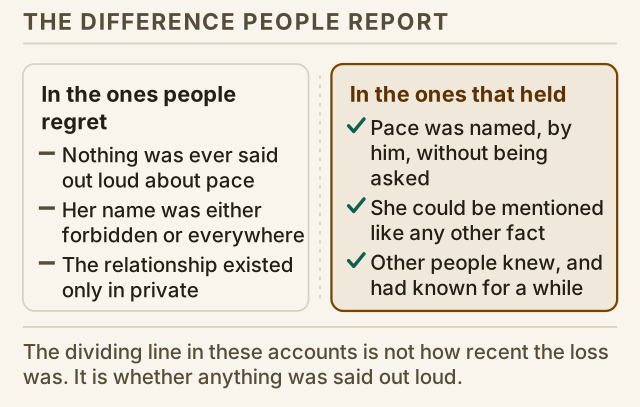
The same grief, and a different willingness to be seen together. That is nearly the entire difference, and it is unglamorous enough to be easy to skip past.
Relationships that go somewhere are not the ones where the man grieves less or talks about her less. Frequently he talks about her more. What is different is that alongside the grief there is a set of small, expensive, logistical facts, such as your name in a diary other people can read, a drawer, a key, a Saturday given up, his sister told before she met you.
There is also usually a different response to being asked a direct question. In the versions that work, a direct question gets a difficult and partly unsatisfying answer that nevertheless contains a position — I want this, and I am not ready to talk about living together. In the versions that end in “never again”, the same question gets warmth, reassurance and no content, and you leave unable to repeat back what was said.
If you want the positive form of this laid out properly, it is on 5 signs a widower is serious about your relationship, and the failure modes are sorted in widower red flags.
How do you read your own situation honestly?
Ask what has changed in six months. Not what was promised, not what was explained, not how you felt after the last good weekend — what is materially different now from half a year ago.
Movement is the signal, and it is nearly the only one available early. A man who could not discuss the future in March and can in September is grieving. A man in an identical position two years apart is not stuck; he has an arrangement that works for him.
The second test is what happens when you name one concrete thing. Choose a fact rather than a feeling — for example, “I have not met your daughter and it has been eight months” — and say it once, plainly, without a case attached. Then listen to the category of the answer, not the tone of it.
A reply that is awkward, incomplete and contains a plan is a different object from a reply that is gentle, moving and contains nothing that could ever happen. Both feel sincere. Only one of them can be checked in a month.
What the numbers can and cannot settle
Very little of this is settled by statistics, and the figures that circulate on the subject are mostly wrong in a specific way: they take a measure of previously married adults and re-label it as a fact about widowers.
The honest version is thin. Pew Research Center found that among U.S. adults whose first marriage ended in divorce or widowhood — a combined group, not a widow-specific one — 64% of men had remarried in 2013, compared with 52% of women. Pew separately reported in 2025 that widows are less likely than divorced adults to remarry, and that women are much more likely than men to be widowed — both statements about women, and neither attached to a widower remarriage percentage, because Pew publishes none.
There is also a demographic point worth holding lightly. The National Center for Family & Marriage Research at Bowling Green State University reports that in 2022, 29.5% of U.S. women aged 65 and older were widowed, compared with 10.3% of men that age. Those are shares within each sex, not a headcount, so the honest statement stops there: a much smaller share of older men than of older women is widowed. It is background to the pace some people encounter, and not an excuse for any of the three complaints above.
What none of this tells you is whether your relationship is going anywhere. No table answers that. The only instrument is the six-month question.
If you are the widowed one reading this
The sentence lands differently if you are the widower rather than the person he was seeing. It is worth saying plainly: the pattern described here is not an accusation against grieving men, and being early in a loss is not a character flaw.
What is inside your control is what gets said and to whom, rather than pace. Nobody can require you to be further along than you are. What a person with you can reasonably ask is to be told the truth about where you are, including “I do not know”, and to be told whether the arrangement is private, why, and until roughly when.
A private relationship with a stated reason and a named review point is a decision two people made. The same relationship without those is something else, whatever either of you intends by it.
When it is not a relationship problem
Some of what gets filed under “he is not ready” is not a scheduling matter at all, and it is not a subject for an article about dating.
If grief has stayed at full intensity long enough that daily life is not functioning, or if there are thoughts of self-harm or of not wanting to be here, that belongs with a doctor or a bereavement service rather than with a partner or with a page like this one. Prolonged, disabling grief is something clinicians treat. We are editors, not clinicians, and the distinction matters more here than almost anywhere else on this site.
The same applies to the person doing the waiting. If this has taken over your sleep and your friendships, the useful next step is a counsellor, not another attempt to interpret his behaviour correctly.
So is “never again” a reasonable rule?
As a rule about widowers, no — it takes the wrong variable from the experience. As a rule about being kept private indefinitely, it is close to sound, and it does not need the word widower in it at all.
The version worth keeping is narrower and more useful: never again a relationship with no witnesses, no direction and no date. That rule costs you nothing, applies to everyone, and would have caught the relationship you are still thinking about.
Where to go next
For the wider picture of what dating a widowed man involves, start at dating a widower. The two pages that do the practical work either side of this one are 5 signs a widower is serious about your relationship and widower red flags. If you are the widowed one, life as a widow or widower is the ground floor underneath all of it, and dating after losing a spouse covers the timing question from that side.