Searching for what to say when a widower pulls away usually means the same thing has happened: he was present, then he was not, and nothing obvious went wrong in between. No argument, no announcement. Shorter replies, then a cancelled evening, then silence with a polite edge to it.
This page is about the small number of sentences that help, the ones that reliably make it worse, and how to tell the two situations apart — the withdrawal that is grief doing what grief does, and the withdrawal that is a man managing you. It is written by editors, and it does not assume you did something wrong. What to say when a widower pulls away is, at its shortest, one message that names what you noticed, says you are not going anywhere, and asks for nothing back.
What does it mean when a widower pulls away?
In the editors’ reading it is capacity, not a verdict. Guilt and exhaustion look identical from the outside, and both make people go quiet. Withdrawal means the retreat itself — shorter replies, a cancelled evening, silence with a polite edge — rather than an announcement that he has stopped wanting this.
The mechanism is unglamorous. Grief is expensive to carry, and a new relationship, even a good one, costs something too — attention, hope, the effort of being a person someone is looking at. When the two bills land in the same week, the newer thing is the one that gets dropped, because it is the one with the least history holding it up.
That is not a compliment and it is not a reassurance. It is simply the difference between a man who has stopped wanting this and a man who has run out of the fuel required to do it this week. In the editors’ reading, the second is what is usually happening — but that is our reading of the pattern, not a measured rate, and we have found no study that counts it.
The other cause worth expecting is one you may never see. A trigger is anything that reopens the loss without warning, such as a date on the calendar, a song, a hospital appointment for something unrelated, or a sentence from one of his children. He may not connect it himself until days later, if at all.
Why does he pull away right after a good weekend?
Because the good weekend can itself be the trigger. This is the version people find hardest to read, and the one that makes them feel insane, because the evidence and the outcome point in opposite directions.
A good weekend, an easy morning, the first time he laughed properly — and then he is gone for four days. Enjoying it registered, somewhere he does not have language for, as a betrayal, and guilt arrives on a delay, often after the evening is over rather than during it.
Knowing this does not make it pleasant. It does change the meaning of the silence: you are not being punished for a mistake, you are on the far end of something that has very little to do with you.
What do you say when a widower pulls away?
Say something short that requires no reply. That is the whole technique, and it is harder than it sounds, because the instinct when someone withdraws is to write the message that fixes it.
Three ingredients, in this order:
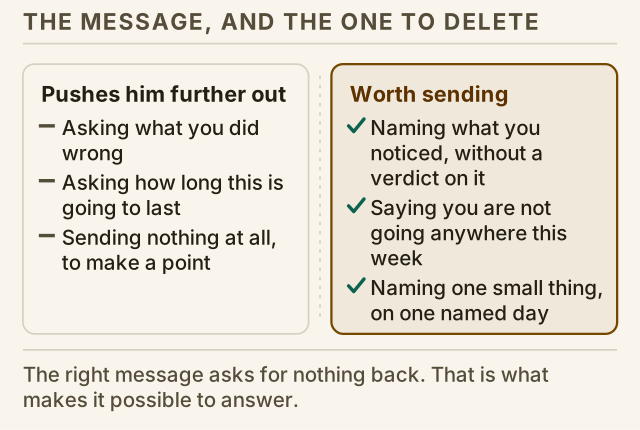
- Name what you noticed, without interpreting it. For example: “You have gone quiet since Sunday.” Not “you have gone quiet since Sunday and I think you are regretting this.”
- Say where you are. “I am around this week, doing ordinary things.” This tells him nothing is being decided in his absence.
- Take the pressure off the reply. “You do not need to answer this.” Then genuinely do not require one.
Assembled, that is roughly: You have gone quiet since Sunday. I am not going anywhere this week. Tell me when you can, and you do not have to answer this now.
Then stop. The most useful thing after a message like that is nothing at all — not a follow-up, not a softer version an hour later, not a photograph designed to seem casual. One message that asks for nothing is reassuring. Three of them are a demand wearing a kind face.
If you want to say something warmer, make it about you rather than about him — for instance, I liked Saturday. That is a statement of fact he does not have to reciprocate.
What should you not say while he is quiet?
Nothing that requires him to reassure you while he is underwater. Everything on this list is understandable and most of it is true. It still lands as a bill.
- “Have I done something wrong?” Now he has to manage your fear as well as his own week.
- “She would want you to be happy.” He has almost certainly heard it already, and it is not yours to say.
- “I can’t compete with a ghost.” Comparison spoken out loud puts a ranking into the room that was not there before.
- “How long is this going to take?” It is not a question he can answer either.
- Apologising for existing. “Sorry, I know I’m too much” invites him to agree.
- A long message explaining your feelings in detail. Send it to a friend. Not because your feelings are unwelcome, but because a five-paragraph message arrives as homework.
There is one thing that is not on this list, despite appearing on lists like this elsewhere: a direct question about the future. Asked once, calmly, at a normal moment rather than during the retreat, a direct question does less damage than the guessing it replaces. It is the timing that decides.
How long should you wait before saying anything else?
Long enough to be kind, not so long that you disappear out of your own life. As a working position, the editors’ answer is a week or so of quiet on your side after one short message, and then a plain conversation.
A week is arbitrary, but arbitrary is useful here. It stops you re-reading the last exchange nightly, and it gives him a stretch of time in which nothing is required of him, which is often exactly what allows a person to come back.
What you are watching for is not speed but return. Return means coming back and giving the silence some account of itself. A man who comes back and says something — even something awkward, even “that was the anniversary and I could not do anything about it” — is doing the thing that keeps a relationship possible. A man who comes back and behaves as though the fortnight did not occur is telling you the pattern is the arrangement.
If the second version happens twice, it is worth naming once, without a case attached: When you go quiet I do not know what is happening, and I would rather you told me it was a bad week than told me nothing.
 Illustration
Why he may have nobody else to say this to
Some of the isolation around a widowed man is structural, and it changes how much of his week you end up carrying.
Widowhood at this stage of life is disproportionately a woman’s experience. The National Center for Family & Marriage Research at Bowling Green State University reports that in 2022, 29.5% of U.S. women aged 65 and older were widowed, compared with 10.3% of men that age. Far fewer men his age are in that position than women his age are. What that measures is the share of people who are widowed, not the composition of anyone’s friendships — but it is the reason a widower can find he has no ready audience for the subject.
It also tends to arrive late. Among U.S. residents aged 15 and over who had been widowed in the previous 12 months, the U.S. Census Bureau found that 71% of men and 69% of women were aged 65 or older, using 2016 American Community Survey data. Loss concentrated in later life often means decades of one marriage and a small circle of people who all knew her.
None of that obliges you to be his only outlet. It does explain why the silence exists — and why “who else knows about this?” is a fair question to ask him once he is back.
When the withdrawal is not about grief
Grief and avoidance produce the same silence, so the test is not the silence itself. It is what happens around it.
Ordinary grief moves. He explains, late and clumsily. The retreats become recognisable — you can name what set one off, and so, eventually, can he. He tells you a hard date is coming before it arrives instead of after.
The other version is static. Every disappearance is followed by warmth and no account of itself, questions become evidence of your impatience, and the relationship never acquires a shape anyone else can see. That is not the loss speaking, and patience on its own is not what changes this pattern. The sorting is done in more detail on widower red flags; for what the good version looks like, see 5 signs a widower is serious about your relationship.
One thing worth saying plainly about the long run: Pew Research Center reported in 2025 that widows are less likely than divorced adults to remarry. That sentence is about women who have been widowed, not a forecast about him, and it is not a reason to accept an arrangement that is making you smaller.
When it is bigger than a bad week
If his withdrawal comes with things that do not belong to ordinary sadness — he is not eating or sleeping for weeks, he cannot work, he is drinking through it, or he says anything about not wanting to be here — that is past the reach of a well-chosen sentence.
Grief itself is not an illness, but there is a point where it needs a clinician rather than a partner. Prolonged grief disorder was added to the DSM-5-TR by the American Psychiatric Association in 2022, and any mention of suicide is its own emergency. The route is his doctor, a bereavement service, or in the United States the 988 Suicide & Crisis Lifeline, which takes calls and texts around the clock. We are editors, not clinicians, and this is not a page that can treat anything.
The same applies to you. If the waiting is eating your sleep and your friendships, that is a conversation for a counsellor, and wanting one does not mean you have failed at being patient.
Where to go next
For the wider picture of what dating a widowed man involves, see dating a widower. If you are the widowed one and the retreating is yours, newly widowed is the ground floor, and widow loneliness covers the part nobody warns you about. For the timing question from his side rather than yours, dating after losing a spouse is the page.